
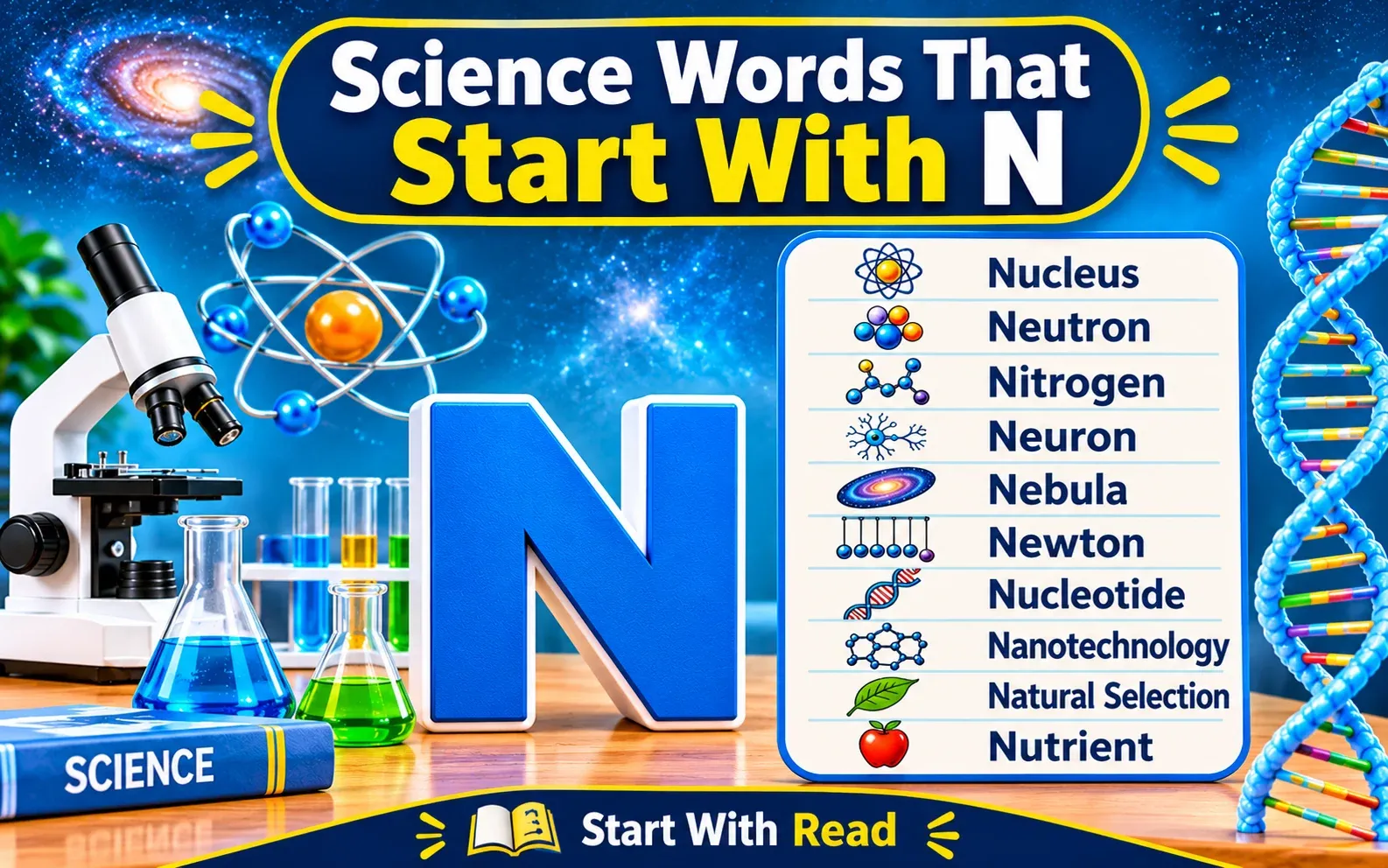
Science Words That Start With N
Common science words that start with N include nucleus, neutron, nitrogen, nebula, neuron, natural selection, and newton. Each word below has a simple meaning. You’ll also find lists sorted by grade (kids through 8th grade) and by subject.
What Are Science Words That Start With N?
Science words that start with N come from biology, chemistry, physics, earth science, space science, and computer science. If you are asking what are some science words that start with N, begin with these ten.
| Science Words That Start With N | Simple meaning | Field |
|---|---|---|
| Nucleus | The center of an atom (it holds protons and neutrons), or the control center of a cell that holds its DNA | Chemistry / Biology |
| Neutron | A particle with no electric charge, found in the nucleus of most atoms | Physics / Chemistry |
| Nitrogen | A gas that makes up about 78 percent of the atmosphere | Chemistry / Earth science |
| Nebula | A giant cloud of dust and gas in space | Space science |
| Neuron | A nerve cell that sends signals. NIH says the human brain has about 86 billion nerve cells | Biology |
| Natural selection | Living things with helpful traits survive and have more young, so those traits become more common over time | Biology |
| Newton | The unit of force: the push that speeds up a 1-kilogram mass by 1 meter per second, every second | Physics |
| Nutrient | A substance, like a vitamin or mineral, that a living thing needs to grow and stay healthy | Biology |
| Nonrenewable resource | A resource that forms too slowly to replace, such as coal, oil, and natural gas | Earth / Environmental science |
| Nocturnal | Active at night, like owls and bats | Biology |
Science Words That Start With N for Kids
These are easy words for kindergarten through 4th grade. Nocturnal and nutrient from the table above work well here too.
| Science Words That Start With N | Easy meaning | Example sentence |
|---|---|---|
| Nature | Everything in the natural world that people did not make | Plants, animals, and weather are all part of nature. |
| Nest | A home animals build to hold their eggs or young | A robin lays its eggs in a nest. |
| Nectar | A sweet liquid made by flowers | Bees collect nectar to make honey. |
| Nerve | A thin cord that carries messages between your body and brain | A nerve in your finger tells your brain the stove is hot. |
| North Pole | The northernmost point on Earth | Earth’s spin axis points through the North Pole. |
| Night | The time when your side of Earth faces away from the Sun | Night happens because Earth spins. |
5th Grade Science Words That Start With N
Core words that fit here: nitrogen, nutrient, and nonrenewable resource. Grade groups in this guide are suggestions. Your teacher’s list or your state’s science standards come first, because official lists differ by state and school.
| Science Words That Start With N | Meaning | Example |
|---|---|---|
| Natural resource | A material from Earth that people use | Water, wood, soil, and oil are natural resources. |
| Nonliving | Not alive, but part of an ecosystem | Rocks, water, and air are nonliving parts of a pond. |
| Neptune | The eighth planet from the Sun. NASA says it is more than 30 times as far from the Sun as Earth | Neptune finished its first full orbit since its 1846 discovery in 2011. |
| Nymph | A young insect that looks like a small adult but has no wings | A grasshopper nymph grows by shedding its skin. |
6th Grade Science Words That Start With N
Core words that fit here: nucleus (in cells) and neuron.
| Science Words That Start With N | Meaning | Example |
|---|---|---|
| Nimbostratus | A thick, dense cloud layer that brings steady rain or snow | A gray sky with all-day drizzle usually means nimbostratus. |
| Neap tide | A moderate tide where high tides are a little lower and low tides a little higher than average. It happens at the first and third quarter moon | Beach walkers see less change between high and low water. |
| Nekton | Animals that swim freely in water, not just drift | Fish, squid, and whales are nekton. |
| Nematode | A tiny roundworm, many of which live in soil | A spoonful of soil can hold nematodes. |
| Nuclear envelope | The double membrane around a cell’s nucleus | Small pores let materials pass in and out. |
7th Grade Science Words That Start With N
Core words that fit here: natural selection and nutrient.
| Science Words That Start With N | Meaning | Example |
|---|---|---|
| Niche | An organism’s role in its ecosystem: what it eats, where it lives, and how it affects others | A bee’s niche includes feeding on nectar and pollinating flowers. |
| Nitrogen cycle | How nitrogen moves between air, soil, water, and living things | See the five steps below. |
| Nitrogen fixation | Turning nitrogen gas (N₂) from the air into forms plants can use, such as ammonia | Lightning can do this too, not just bacteria. |
| Nitrate | A form of nitrogen (NO₃⁻) that plant roots can absorb | Fertilizer adds nitrates to soil. |
| Neutralization | A reaction between an acid and a base that makes a salt and water | Antacid tablets neutralize extra stomach acid. |
Why nitrogen fixation matters: Air is mostly nitrogen, but most organisms can’t use N₂ directly because the bond between the two atoms is so strong. Without fixation, plants would run short of nitrogen, and so would the animals that eat them.
Textbooks describe five main steps in the nitrogen cycle:
| Step | What happens | Example |
|---|---|---|
| 1. Fixation | N₂ from air becomes ammonia or ammonium | Bacteria in bean-plant root nodules |
| 2. Nitrification | Soil bacteria change ammonium into nitrate | Nitrate builds up in healthy soil |
| 3. Assimilation | Plants take in nitrogen to build proteins. Animals get it by eating plants | A cow eats grass |
| 4. Ammonification | Decomposers break dead matter and waste into ammonium | A fallen leaf rots |
| 5. Denitrification | Bacteria turn nitrate back into N₂ gas | Nitrogen returns to the air |
8th Grade Science Words That Start With N
Most of these are physical science terms. Neutron and newton from the first table fit here too.
| Science Words That Start With N | Meaning | Example or good-to-know |
|---|---|---|
| Newton’s laws of motion | Three rules about force and motion. The second law is F = m × a | A 2 kg object speeding up at 3 m/s² needs a 6 N net force. |
| Nuclear fission | Splitting a large nucleus into smaller ones, which releases energy | Nuclear power plants use fission. |
| Nuclear fusion | Joining small nuclei into a larger one, which releases energy | The Sun fuses hydrogen into helium. |
| Neutral (pH) | Neither acidic nor basic, at pH 7 | Pure water is neutral. |
| Neutron star | The superdense leftover of a massive star, about 12 miles wide, where a teaspoon of matter would weigh about a billion tons | Estimates of the weight vary by source. |
Physical Science Words That Start With N
Physical science covers matter, energy, forces, and light. Words above that belong here too: neutron, newton, nuclear fission, nuclear fusion, and neutral.
| Science Words That Start With N | Meaning | Example |
|---|---|---|
| Net force | The total of all forces on an object, counting direction | Two equal pushes in opposite directions give a net force of 0 N. |
| Normal force | The push a surface gives back to an object resting on it | A table pushes up on a book. |
| Nuclear energy | Energy released by changes in an atom’s nucleus | Nuclear plants made about 19% of U.S. electricity in 2024. |
| Nanometer | One-billionth of a meter. A sheet of paper is about 100,000 nanometers thick | Scientists use nanometers for atoms and tiny particles. |
Chemical Elements That Start With N
| Element | Symbol | Atomic number | Good to know |
|---|---|---|---|
| Nitrogen | N | 7 | Makes up most of the air |
| Neon | Ne | 10 | Glows reddish-orange in sign tubes |
| Nickel | Ni | 28 | Used in stainless steel |
| Niobium | Nb | 41 | Used in some special steels and magnets |
| Neodymium | Nd | 60 | Used in strong magnets |
| Neptunium | Np | 93 | Radioactive, named after the planet Neptune |
| Nobelium | No | 102 | Radioactive, made in labs |
| Nihonium | Nh | 113 | Superheavy, made in labs |
Life Science Words That Start With N
Life science is the study of living things. Words above that belong here too: neuron, nucleus, nutrient, natural selection, nocturnal, nectar, and nematode.
| Science Words That Start With N | Meaning | Example |
|---|---|---|
| Nervous system | The brain, spinal cord, and nerves that control the body | It lets you feel, think, and move. |
| Nerve impulse | An electrical signal that travels along a neuron | Touching something hot sends an impulse to your brain. |
| Nucleolus | A dense spot inside the nucleus that helps make ribosomes | A cell diagram shows it inside the nucleus. |
| Nucleotide | A building block of DNA and RNA | DNA is a long chain of nucleotides. |
| Nitrogen-fixing bacteria | Bacteria that turn nitrogen gas into usable forms | Some live in root nodules of peas and beans. |
Earth and Space Science Words That Start With N
Earth and space science covers rocks, oceans, weather, and the sky. Words above that belong here too: nebula, Neptune, neap tide, nimbostratus, neutron star, and North Pole.
| Science Words That Start With N | Meaning | Example |
|---|---|---|
| Nova | A star that suddenly gets much brighter, then fades | Astronomers watch the sky for new novas. |
| Normal fault | A crack in Earth’s crust where one block slides down as the crust is pulled apart | Basin-and-range landscapes have many. |
| Northern lights | Glowing lights near the poles, made when charged particles from the Sun hit gases in the air | Also called aurora borealis. |
| Natural gas | A fossil fuel gas, mostly methane, formed from ancient living things | Many homes use it for heating. |
| Nunatak | A rocky peak that sticks up through a glacier or ice sheet | Hikers in icy regions may spot one. |
Environmental Science Words That Start With N
Environmental science looks at how people and nature affect each other. Nonrenewable resource and natural resource from above belong here too.
| Word | Meaning | Example |
|---|---|---|
| Nonpoint source pollution | Pollution from many spread-out sources, carried by rainfall or snowmelt moving over and through the ground | Oil, fertilizer, and pet waste washed off streets and lawns |
| Nutrient pollution | Too much nitrogen or phosphorus in water | It can cause algae blooms. |
| Native species | A species that lives naturally in an area | The bald eagle is native to North America. |
| Noise pollution | Unwanted or harmful sound from human activity | Ship noise can disturb whales. |
| Nuclear waste | Radioactive leftovers that need long-term safe storage | Used fuel from nuclear power plants |
Computer Science Words That Start With N
These are not natural science words, but they show up in science and STEM classes.
| Word | Meaning | Example |
|---|---|---|
| Node | A point in a network or data structure that holds data or links to others | Each computer on a network is a node. |
| Network | Connected devices that share data | Your home Wi-Fi is a network. |
| Neural network | A machine learning model that stacks simple “neurons” in layers and learns patterns from data | Used in image and speech tools |
| NULL | A special value meaning “no value” | A blank database field can be NULL. Zero is different. |
| NAND gate | A logic gate whose output is false only when all inputs are true | Inputs 1 and 1 give 0. |
| Natural language processing (NLP) | Teaching computers to work with human language | Translation and chatbots |
| Nibble | Four bits, or half a byte | The binary number 1010 is one nibble. |
| Nanosecond | One-billionth of a second | Computers measure some tasks in nanoseconds. |
How to Remember N Science Words
Memory tricks work because they link a new word to something you already know.
| Word | Memory trick | Why it helps |
|---|---|---|
| Neutron | It sounds like neutral: no charge | Ties the name to its key fact. |
| Nucleus | Nucleus means “center” in atoms and cells | One idea covers both uses. |
| Neap tide | Neap = narrow: the gap between high and low tide is smallest | Matches the small tidal range. |
| Nocturnal | Night-active: both words start with N | Gives you an easy anchor. |
| Nitrogen cycle | Fix, Nitrify, Absorb, Decompose, Return | Keeps the five steps in order. |
Common N Mix-Ups
Many wrong answers on tests come from words that look or sound alike.
| Pair | The difference | Example |
|---|---|---|
| Newton vs. newton | Isaac Newton is the scientist. The unit is spelled in lowercase (newton), and its symbol is N | A 6 N force is “six newtons.” |
| Nucleus vs. nucleolus | The nucleus is the cell’s control center. The nucleolus is a small spot inside it | A nucleolus sits inside the nucleus. |
| Neuron vs. nerve | A neuron is one cell. A nerve is a bundle of neuron fibers | Your arm nerve holds many neurons’ fibers. |
| Nebula vs. galaxy | A nebula is a cloud of gas and dust. A galaxy is a huge system of stars, gas, and dust | Many nebulae are inside our galaxy. |
| Neap tide vs. spring tide | Neap tides have a small range. Spring tides have the biggest range and happen at new and full moon. Spring tides have nothing to do with the season | A beach shows more change at a spring tide. |
| Nitrogen vs. nitrate | Nitrogen is the element or gas. Nitrate is a form plants absorb from soil | Roots take in nitrate, not N₂ gas. |
Quick Check: Can You Name the N Word?
Cover the right column and try the clues.
| Clue | Answer |
|---|---|
| A gas that makes up about 78% of air | Nitrogen |
| A cloud of gas and dust in space | Nebula |
| The unit of force | Newton |
| A cell that sends nerve messages | Neuron |
| A particle in the nucleus with no charge | Neutron |
| Active at night | Nocturnal |
| The tide with the smallest range | Neap tide |
